
Blog
Why Your Family Needs to Switch to Gluten-Free Millet Flour Right Now

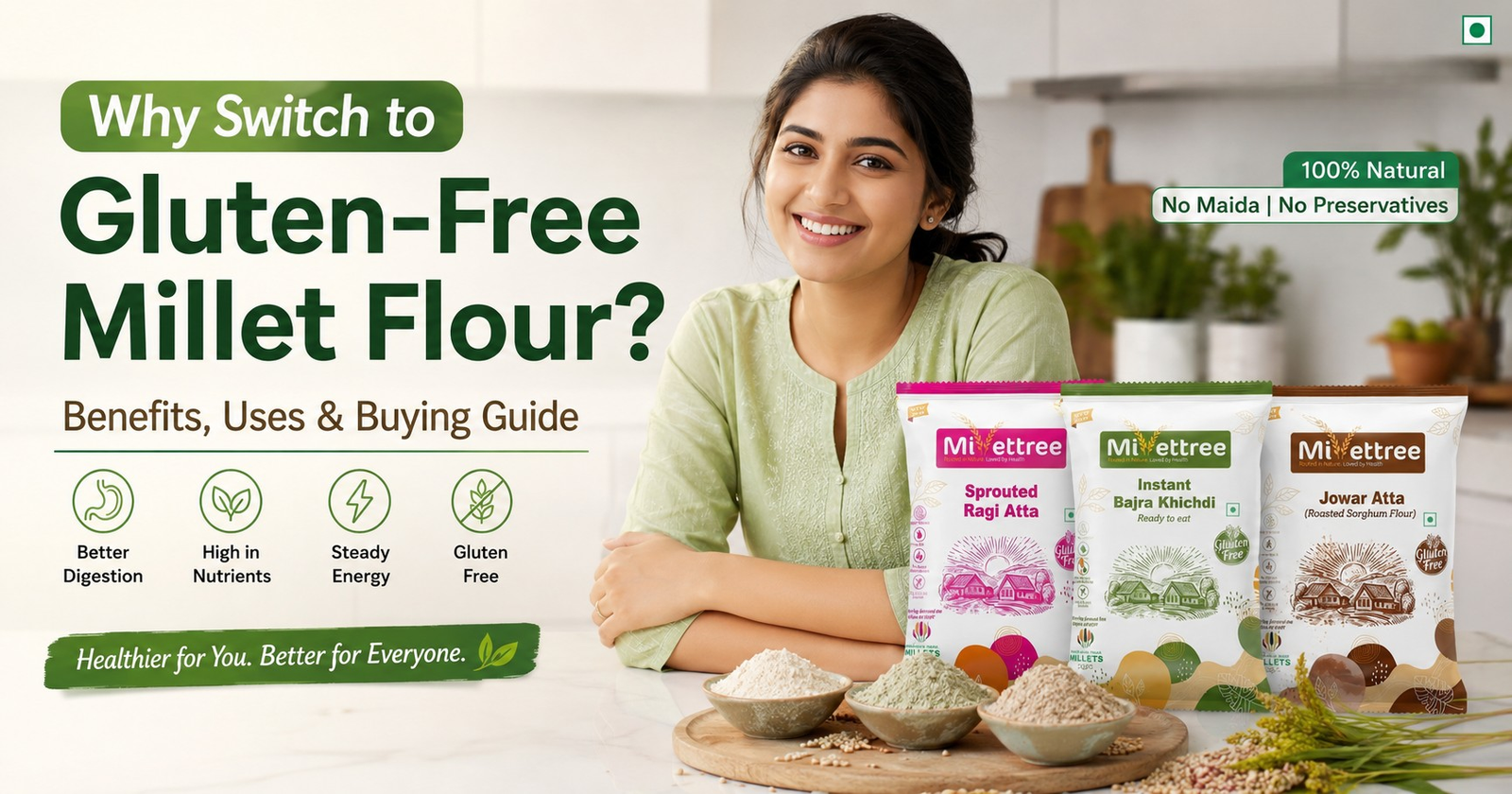
What is Gluten and Why Does It Matter?
Gluten is a family of proteins found in wheat, barley, and rye. In wheat specifically, the two main gluten proteins are glutenin and gliadin. Together they create the elastic network that gives wheat dough its stretchiness, bread its chewy texture, and rotis their pliability. From a purely functional cooking standpoint, gluten is useful. From a health standpoint, its effects are more complicated and more wide-ranging than most people realise.
For people with coeliac disease, an autoimmune condition affecting roughly 1 in 100 people globally, gluten triggers an immune response that damages the villi lining the small intestine. This damage impairs nutrient absorption and causes a cascade of symptoms including chronic diarrhoea, abdominal pain, anaemia, fatigue, and over the long term, serious nutritional deficiencies. For this group, avoiding gluten is not a lifestyle choice. It is a medical necessity.
For people with non-coeliac gluten sensitivity, a condition that is now recognised as distinct from coeliac disease and believed to affect a significantly larger proportion of the population, gluten consumption causes many of the same symptoms, including bloating, fatigue, brain fog, headaches, joint pain, and digestive discomfort, without the autoimmune intestinal damage that characterises coeliac disease. These individuals often go undiagnosed for years because standard coeliac tests return negative results, while their symptoms continue.
But here is the part that most people have not yet heard: the research increasingly suggests that gluten and refined wheat products have meaningful negative effects on health even in people who have no sensitivity, no allergy, and no diagnosis of any kind.
Why Reducing Gluten Benefits Everyone, Not Just Those With a Diagnosis
This is the most important section of this blog and the one that is most frequently left out of conversations about gluten-free eating. The benefits of switching from refined wheat to millet flours extend far beyond the diagnosed minority. Here is the evidence.
Gliadin and Intestinal Permeability in All People
Research published in peer-reviewed gastroenterology journals has shown that gliadin, one of the primary gluten proteins in wheat, triggers the release of a protein called zonulin in the gut. Zonulin regulates the tight junctions between the cells lining the intestinal wall. When zonulin is released, these junctions loosen temporarily, increasing what researchers call intestinal permeability, more commonly known as leaky gut.
This effect has been demonstrated in all people who consume gluten, not just those with coeliac disease or sensitivity. In most healthy individuals, the effect is transient and the gut recovers. But in people who consume refined wheat products multiple times a day, every day, as most Indian households do, this repeated loosening of the gut barrier may contribute to a low-grade, chronic increase in intestinal permeability over time. Increased intestinal permeability allows partially digested food particles and bacterial fragments to cross the gut wall and enter the bloodstream, where they can trigger immune responses and systemic inflammation in tissues and organs far from the digestive tract.
Chronic Low-Grade Inflammation
The systemic inflammation that can result from chronic increased intestinal permeability is not the acute, visible inflammation of an injury or infection. It is a persistent, low-level inflammatory state that does not announce itself dramatically but silently contributes to a range of conditions over years and decades. These include fatigue and poor energy, skin conditions like eczema and acne, joint stiffness and pain, brain fog and poor concentration, disrupted sleep, and over the long term, elevated risk of metabolic disorders, cardiovascular disease, and certain autoimmune conditions.
Many people who reduce refined wheat and replace it with millet flours report improvements in several of these symptoms within weeks, not because they had a formal diagnosis, but because they removed a chronic low-level irritant from their daily diet and their bodies responded. This is not an anecdotal outlier experience. It is a pattern that is consistent enough across enough people to be taken seriously.
Gut Microbiome Diversity
Refined wheat flour, particularly maida, provides almost no prebiotic fibre for the beneficial bacteria in your large intestine. A diet heavily reliant on maida-based products contributes to a less diverse gut microbiome over time. Reduced microbiome diversity is now associated in research with a wide range of health concerns beyond digestion, including weakened immunity, increased susceptibility to infection, poor mood regulation, higher rates of anxiety and depression, reduced insulin sensitivity, and greater difficulty maintaining healthy body weight.
Millet flours, by contrast, are rich in the kinds of dietary fibre that specifically feed and diversify beneficial gut bacteria. The shift from refined wheat to millet flours is therefore not just a change in what you are removing from your diet. It is a change in what you are actively providing to the trillions of microorganisms that make up your gut microbiome, with consequences that extend across virtually every system in the body.
Blood Sugar Stability for Non-Diabetics
Even for people with no diabetes, no pre-diabetes, and no diagnosed blood sugar issue, the high glycaemic index of refined wheat flour causes daily blood sugar volatility that has real effects on energy, mood, and appetite. The familiar experience of feeling energised after a maida-based breakfast and then crashing into fatigue and hunger by mid-morning is a direct consequence of the blood sugar spike and subsequent insulin surge that refined wheat produces. Over years, this daily pattern of spikes and crashes contributes to a gradual decline in insulin sensitivity even in people who were never at obvious risk.
Millet flours, with their low to medium glycaemic index, deliver carbohydrates in a way that maintains stable blood sugar throughout the day. The difference is felt within days of making the switch and accumulates meaningfully over months and years.
Why Millet Flours Are Superior to Most Gluten-Free Alternatives
The gluten-free market in India is growing rapidly, but much of what fills it is nutritionally problematic in a different way. Products made from refined rice flour, potato starch, tapioca, or corn starch are technically gluten-free but nutritionally hollow. They may remove the gluten, but they replace it with ingredients that spike blood sugar, provide almost no fibre, and contribute nothing of mineral or protein value. Switching from maida to refined rice flour is trading one nutritional problem for another.
Millet flours are categorically different. They are genuinely gluten-free and genuinely nutritious.
| Flour | Calcium | Iron | Fibre | Protein | GI |
| Wheat maida | 16 mg | 1.2 mg | 2.7 g | 9.3 g | 70 |
| Rice flour | 10 mg | 0.3 mg | 2.4 g | 6 g | 72 |
| Ragi flour | 344 mg | 3.9 mg | 3.6 g | 7.3 g | 54 |
| Bajra flour | 42 mg | 8 mg | 8.5 g | 11 g | 55 |
| Jowar flour | 28 mg | 13.8 mg | 6 g | 10 g | 62 |
The contrast is stark and speaks for itself. Ragi flour contains more than 21 times the calcium of maida. Bajra flour contains more than 6 times the iron of maida and more than three times the fibre. Jowar flour contains more than 11 times the iron of maida with a glycaemic index nearly 10 points lower. These are not marginal improvements. They are fundamental differences in what each flour does for your body with every meal.
How to Make the Switch Without Disrupting Your Cooking
The most important thing to know about switching to millet flours is that you do not need to do it overnight, and you do not need to sacrifice the familiar flavours and textures your family is comfortable with.
Start with a 25 percent blend. Replace one quarter of your regular wheat atta with Millettree Roasted Ragi Flour or Roasted Bajra Flour when making rotis. The texture will be slightly denser but the flavour is pleasant, nutty, and almost universally well received even by family members who are initially sceptical.
Move to a 50 to 50 blend once your household is comfortable. This is the point at which the nutritional upgrade becomes genuinely meaningful in terms of daily mineral and fibre intake, while the texture remains familiar enough for regular use.
Introduce 100 percent millet meals for specific preparations. Jowar rotis, bajra rotis, and ragi dosas are all traditionally made with 100 percent millet flour and require no wheat at all. These are excellent meals to introduce as dedicated millet days, where the full flavour and nutrition of the grain comes through without any blending.
Use millet flours in baking. Ragi and jowar flour substitute effectively in cakes, cookies, muffins, and pancakes, where the gluten structure is less critical to the final texture. Ragi banana bread, jowar cookies, and ragi pancakes are all popular with children and adults who would not necessarily eat millet rotis.
Who Benefits Most from Switching
Diabetics and pre-diabetics benefit from the significantly lower glycaemic index of all three millet flours compared to wheat or rice. Children benefit from the superior calcium and iron content that supports bone development, cognitive function, and healthy growth. Women over 35 benefit from ragi’s exceptional calcium content, which supports bone density during the years when calcium loss begins to accelerate. People with frequent bloating or digestive discomfort benefit from removing refined wheat, which is often a contributing factor even without a formal diagnosis. And anyone aiming for better gut health, more stable energy, lower systemic inflammation, and a stronger immune system benefits from the fibre, minerals, and prebiotic properties that millet flours deliver with every meal.
Conclusion
The conversation about gluten-free eating has for too long been limited to those with coeliac disease and formal diagnoses. The science now tells a broader and more important story: refined wheat products, consumed daily and in the quantities typical of most Indian households, contribute to intestinal permeability, systemic inflammation, gut microbiome disruption, and blood sugar instability in virtually everyone, regardless of diagnosis. The solution is not to fear food or pursue extreme elimination diets. It is simply to replace a nutritionally inferior flour with something dramatically better.
Millet flours, ragi, bajra, and jowar, are not alternative health products. They are the original flours of the Indian subcontinent, eaten by generations of Indians long before refined wheat became dominant. They are gluten-free, mineral-dense, fibre-rich, and lower on the glycaemic index than anything the modern food industry has produced to replace them. Switching to millet flours is not a sacrifice or a compromise. It is a return to something better, something that nourishes your gut, stabilises your blood sugar, builds your bones, and feeds the beneficial bacteria that govern more of your health than most people realise. Start with a 25 percent blend in your next batch of rotis, and let the results guide the rest of the journey.
Internal Links: Complete Gluten-Free Kitchen Set | Roasted Jowar Flour | Sprouted Ragi Atta