
Blog
Millets vs Quinoa: Which Superfood Wins for Indian Households?

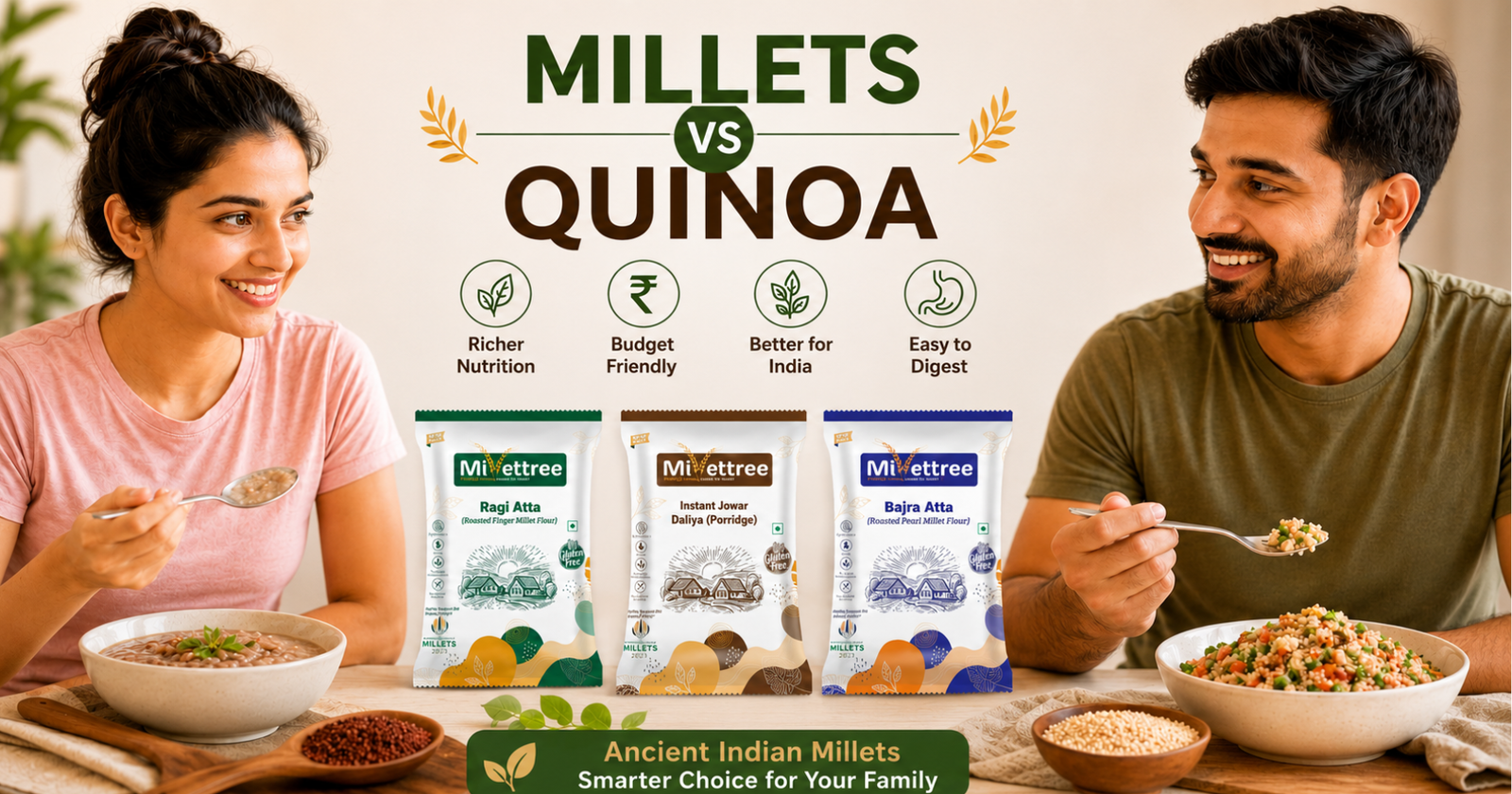
What is Quinoa?
Quinoa (Chenopodium quinoa) is a seed native to South America. It gained global fame as a “complete protein” because it contains all nine essential amino acids — a rarity among plant foods. It is also gluten-free, high in fibre, and has a moderate glycaemic index.
What are Millets?
Millets are a group of small-seeded grasses that have been cultivated in India, Africa, and Asia for thousands of years. The most common Indian millets include ragi (finger millet), bajra (pearl millet), jowar (sorghum), foxtail millet, and kodo millet. The United Nations declared 2023 the International Year of Millets, recognising their nutritional and ecological importance on a global scale.
Nutritional Comparison (per 100 g, cooked)
| Nutrient | Quinoa | Ragi (Finger Millet) | Bajra (Pearl Millet) | Jowar (Sorghum) |
| Calories | 120 kcal | 108 kcal | 116 kcal | 110 kcal |
| Protein | 4.4 g | 3.5 g | 3.5 g | 3.7 g |
| Calcium | 17 mg | 344 mg | 42 mg | 28 mg |
| Iron | 1.5 mg | 3.9 mg | 8 mg | 1.6 mg |
| Fibre | 2.8 g | 3.6 g | 1.3 g | 1.7 g |
| Gluten-Free | ✅ | ✅ | ✅ | ✅ |
The numbers tell a striking story. Ragi’s calcium content is nearly 20 times that of quinoa — extraordinary for a plant food. Bajra’s iron content is more than five times higher. These are precisely the minerals where Indian diets are most commonly deficient.
Cost Comparison
Quinoa imported into India typically costs ₹250–500 per 500 g. Millettree’s Roasted Ragi Flour or Bajra Flour costs a fraction of that — and is locally grown, supporting Indian farmers and reducing your carbon footprint. For families consuming grains daily, the cost difference over a month is substantial.
Taste and Culinary Fit
Quinoa has a mild, slightly nutty taste but requires rinsing and has a texture many Indian home cooks find unfamiliar. Millets, on the other hand, form the foundation of beloved regional dishes — ragi mudde, bajra khichdi, jowar roti, millet porridge. They blend seamlessly into Indian cooking without disrupting meal habits or requiring a pantry overhaul.
How to Cook Millets at Home
One of the biggest hesitations people have about switching to millets is not knowing where to start in the kitchen. The good news: millets are easier to cook than quinoa, and far more flexible.
Ragi (Finger Millet) Use Millettree Roasted Ragi Atta directly in your rotis — replace 30–50% of your regular wheat flour for a nutrient boost without changing the taste dramatically. For porridge, mix 2 tablespoons of ragi flour in water, cook on low heat for 5–7 minutes, and sweeten lightly with jaggery or dates.
Bajra (Pearl Millet) Bajra rotis are a winter staple across Rajasthan and Punjab. Knead bajra flour with warm water and a pinch of salt, shape into thick rotis, and cook on a tawa with ghee. The flavour is earthy and deeply satisfying.
Jowar (Sorghum) Jowar flour makes excellent bhakri and can be used for dosas, pancakes, and even upma. It has a mild taste that absorbs spices well.
Quick Option — No Cooking Required Millettree’s Instant Ragi South Indian Mix Soup and Instant Ragi Tomato Soup are ready in under 2 minutes — pour hot water, stir, and serve. Perfect for busy mornings or an evening snack.
Glycaemic Index and Diabetes Management
Ragi has a GI of around 54, bajra around 55, and jowar around 62 — all classified as low to medium. Quinoa’s GI is comparable at around 53. The key difference is that millets also carry additional antioxidants and polyphenols that further support blood sugar management, making them a well-rounded choice for diabetics.
Environmental Sustainability
Millets are drought-resistant crops that require significantly less water than wheat, rice, or even quinoa. They grow in semi-arid conditions without heavy pesticide use. Every time you choose Indian millets, you are supporting sustainable agriculture and the livelihoods of small-scale Indian farmers.
Verdict
For Indian households, millets are the smarter, more affordable, more sustainable, and equally nutritious choice compared to quinoa. The variety within millets — ragi for calcium and iron, bajra for energy and minerals, jowar for digestive health — means you are never locked into one grain and never bored with your meals.
Start with Millettree’s range of roasted millet flours and instant millet meals to bring these ancient grains back to your daily routine.
Is quinoa better than ragi?
Not when you look at the full nutritional picture. Quinoa edges ahead on protein — 4.4 g per 100 g versus ragi’s 3.5 g — and it does contain all nine essential amino acids. But ragi delivers nearly 20 times more calcium and more than twice the iron of quinoa. For Indian diets where calcium and iron deficiency are common, ragi addresses far more pressing nutritional gaps. Quinoa’s “superfood” reputation was largely built on Western nutrition priorities; for Indian bodies and Indian cooking, ragi is the stronger choice.
Which grain is best for weight loss — millet or quinoa?
Both support weight management, but millets have a practical edge for Indian households. Ragi and bajra are high in dietary fibre, digest slowly, and keep you full for longer — reducing the urge to snack between meals. The key difference is that millets fit naturally into Indian cooking. Replacing your regular atta with Millettree Roasted Ragi Atta in rotis or using bajra for bhakri requires no new recipes or habits, making it far easier to stay consistent. And consistency is what drives weight loss results.
Why is quinoa so expensive in India?
Quinoa is not grown in India at any significant scale. Almost all quinoa consumed in Indian cities is imported from Peru, Bolivia, or other South American countries, which adds shipping, import duties, and retailer margins to the final price. Millets, by contrast, have been grown across India for thousands of years. They are part of the domestic agricultural supply chain, which is why they cost a fraction of what quinoa does while delivering comparable or superior nutrition.
Can I replace quinoa with millets in recipes?
Yes — in most cases, very easily. Here are a few direct swaps:
- Quinoa salad → Use cooked foxtail millet or kodo millet. They hold their shape well and absorb dressings beautifully.
- Quinoa porridge / breakfast bowl → Ragi porridge with jaggery, banana, and nuts is a richer, more filling substitute.
- Quinoa pulao or upma → Jowar or barnyard millet works well as a base with the same spices and vegetables.
- Quinoa flour in baking → Substitute Millettree Roasted Ragi Atta at a 1:1 ratio in most baked goods.
The flavour profiles are slightly different — millets are more earthy and robust — but most people find them more satisfying than quinoa’s mild, slightly bitter taste.
Which millet is closest to quinoa in protein?
Jowar (sorghum) is the closest match, with about 3.7 g of protein per 100 g cooked — just below quinoa’s 4.4 g. Foxtail millet and kodo millet also offer comparable protein levels. If protein is your primary concern, combine any millet with a good dal, curd, or egg — the combination provides a complete amino acid profile similar to quinoa, at a fraction of the cost.
Internal Links: Roasted Bajra Flour | Instant Jowar Dalia | Fitness & Metabolism Combo