
Blog
Jowar (Sorghum) Health Benefits: Why This Gluten-Free Grain Is a Diabetes Game-Changer

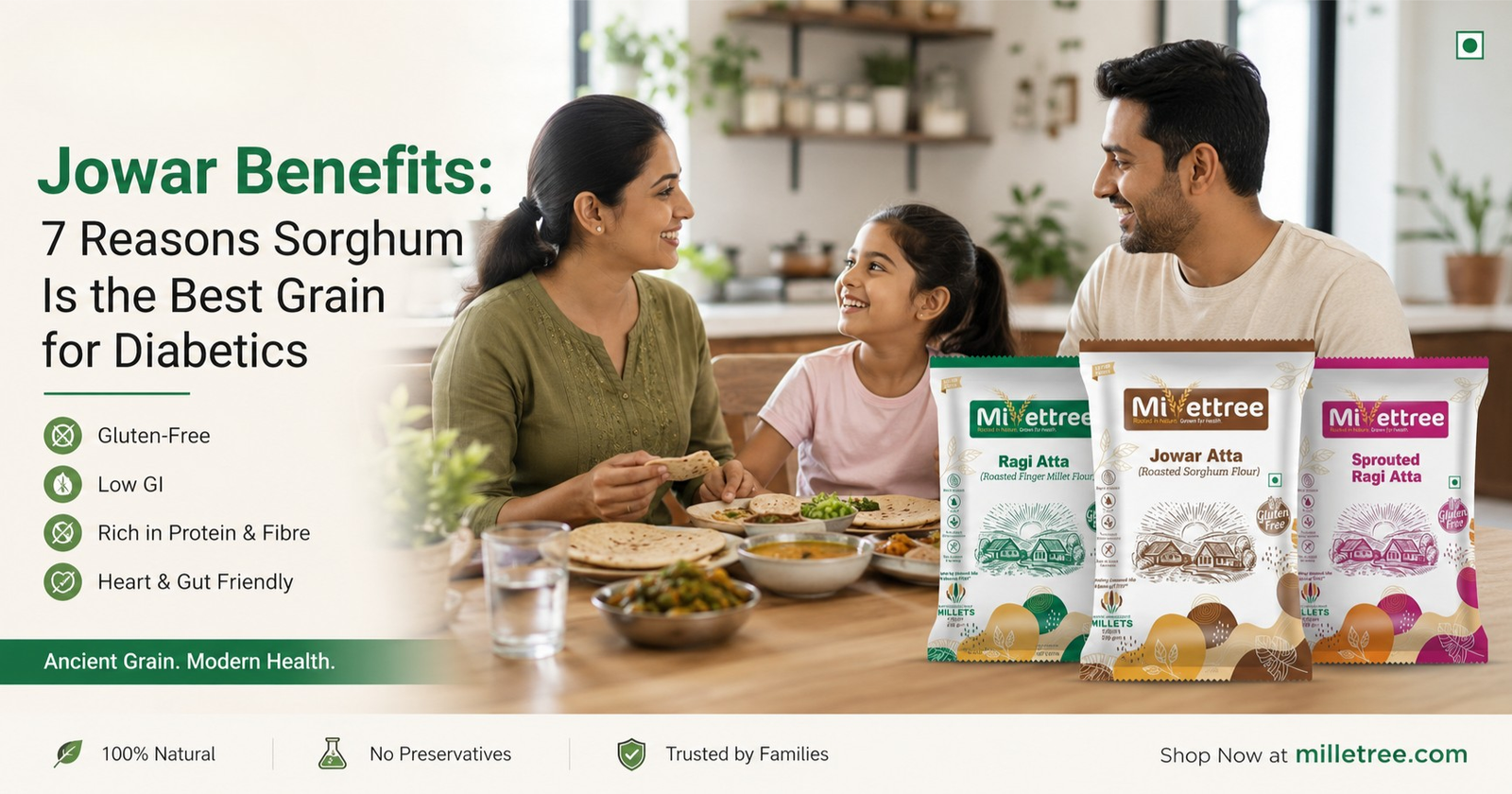
What Makes Jowar Special?
Per 100 g raw, jowar provides around 330 calories, 10 g of protein, 6 g of fibre, 13.8 mg of iron, and a respectable 25 mg of calcium. It is completely gluten-free, has a low glycaemic index of approximately 62, and contains a unique and remarkable set of antioxidants called tannins and 3-deoxyanthocyanidins that are not found in significant quantities in most other commonly eaten grains. These compounds are not minor nutritional footnotes. They are bioactive substances with documented effects on blood sugar, cancer cell activity, cholesterol, and inflammation that make jowar genuinely unlike any other grain on the Indian market.
What makes jowar even more practically significant is its versatility. It cooks and behaves in ways that make it genuinely suitable for everyday Indian cooking, not just as a health food eaten reluctantly, but as a delicious, satisfying grain that can replace wheat in most applications without requiring any fundamental change in cooking habits or meal preferences.
- The Best Gluten-Free Grain for Rotis and Flatbreads
Among all the gluten-free flour alternatives available in India, jowar stands apart for one practical reason that matters enormously in daily cooking: it makes genuinely good rotis. This is not something that can be said of most gluten-free flours. Rice flour produces brittle, fragile flatbreads with a bland, starchy taste. Almond flour is expensive, calorie-dense, and produces a texture that bears no resemblance to a traditional roti. Tapioca and potato starch-based flours are nutritionally hollow and behave poorly on a tawa.
Jowar flour, by contrast, makes soft, pliable rotis that hold together well, have a pleasant mild flavour, and absorb the taste of dal, sabzi, or chutney beautifully without overpowering the accompaniment. With a little practice, jowar rotis are indistinguishable in texture and cooking behaviour from the wheat rotis most Indian households have been making for decades. The transition is genuinely seamless in a way that no other gluten-free flour can claim.
Millettree’s Roasted Jowar Atta makes this substitution even more accessible. The roasting process improves shelf life significantly, reduces the raw grain smell that some people find off-putting in plain jowar flour, and produces a smoother milling texture that is more forgiving to work with for those new to millet-based cooking.
- Exceptional for Blood Sugar Management
This is where jowar’s scientific credentials are strongest and where its impact on daily health is most profound. Jowar has a glycaemic index of approximately 62, which is classified as low to medium and is significantly lower than white rice, which has a GI of around 72, and white wheat flour, which has a GI of approximately 70 for maida and around 65 for whole wheat atta.
But the GI number alone understates what jowar does for blood sugar management. Jowar’s slow-digesting resistant starch and high fibre content work together to physically slow the rate at which glucose is released from a jowar meal into the bloodstream. On top of this, jowar contains phenolic compounds, specifically tannins and caffeic acid, that have been shown in research to inhibit alpha-amylase and alpha-glucosidase, the digestive enzymes responsible for breaking down starch into glucose. By partially inhibiting these enzymes, jowar effectively reduces the amount of glucose that enters the bloodstream from a given meal, independently of the fibre effect.
This dual mechanism, slow physical digestion through fibre and resistant starch, combined with enzymatic inhibition through phenolic compounds, makes jowar one of the most effective grain choices available for managing post-meal blood glucose spikes. Research published in peer-reviewed nutrition journals has specifically identified sorghum consumption as beneficial for people with Type 2 diabetes, and it is now frequently recommended by endocrinologists and dietitians working with diabetic patients in India as a direct replacement for white rice and wheat flour in daily meals.
For the approximately 77 million Indians currently living with Type 2 diabetes, and the estimated 136 million in the pre-diabetic range, this is not a minor lifestyle consideration. It is one of the most impactful single dietary changes available without medication.
- Powerful Plant-Based Protein
With around 10 g of protein per 100 g raw, jowar is among the highest-protein millets and compares favourably with whole wheat, which provides around 12 to 13 g per 100 g. For a gluten-free grain, this protein content is exceptional. Most gluten-free alternatives like rice flour, tapioca, or potato starch provide 6 g or less per 100 g.
This is particularly valuable for the large majority of Indian households that follow a vegetarian or predominantly vegetarian diet and rely on grains as a significant contributor to their daily protein intake. The protein in jowar includes several essential amino acids, and while jowar is somewhat limited in lysine compared to animal proteins, this limitation is easily and completely addressed by pairing jowar rotis or upma with dal or legumes, as is already customary in Indian cooking. The amino acid profile of the grain and the dal together form a complete protein that the body can use as effectively as animal protein.
Beyond the quantity of protein, jowar’s protein is also more bioavailable than the protein in many other cereals because jowar contains lower levels of protein-binding anti-nutrients than grains like wheat. The protein you eat from a jowar meal is therefore more fully absorbed and utilised by the body than the equivalent protein from many other grain sources.
- Heart Health and Cholesterol Reduction
Jowar’s contribution to cardiovascular health operates through multiple independent pathways simultaneously, which is what makes it particularly effective as a heart-protective food rather than simply a food that addresses one risk factor in isolation.
The soluble fibre in jowar binds to bile acids in the digestive tract. Bile acids are made from cholesterol, and when they are bound by fibre and excreted rather than reabsorbed, the liver compensates by drawing cholesterol from the blood to make more bile acids. The net result is a measurable reduction in circulating LDL cholesterol. Multiple studies have specifically demonstrated that regular sorghum consumption reduces LDL cholesterol levels in human subjects, with the effect being most pronounced in people with elevated baseline cholesterol.
The magnesium in jowar plays a separate but complementary role, supporting healthy electrical activity in the heart and reducing the risk of arrhythmia. Potassium works alongside magnesium to relax blood vessel walls, reducing the resistance against which the heart must pump and thereby lowering blood pressure. The polyphenols in jowar have their own anti-inflammatory action on arterial walls, reducing the oxidative damage that contributes to atherosclerotic plaque formation over time.
For Indian households with a family history of cardiovascular disease, which is among the most common causes of premature death in India, replacing refined wheat and rice with jowar across even one or two meals a day addresses multiple cardiovascular risk factors simultaneously through a single, affordable, culturally familiar food.
- Anti-Cancer Properties
Jowar contains a class of antioxidants called 3-deoxyanthocyanidins that are found in very few other food sources and have attracted significant scientific interest for their demonstrated ability to inhibit the growth of cancer cells in laboratory studies. These compounds have shown particular activity against human colon cancer cells and oesophageal cancer cells in controlled research settings.
It is important to be clear about what the evidence currently shows and what it does not. Laboratory studies and cell-line research demonstrate that these compounds can inhibit cancer cell proliferation under controlled conditions. Large-scale human clinical trials specifically testing sorghum’s anti-cancer effects in human populations are still ongoing. What is additionally available, however, is population-level epidemiological data showing that communities in sub-Saharan Africa and parts of India where sorghum is a primary dietary staple have historically lower rates of certain digestive tract cancers compared to populations eating predominantly refined wheat and rice. This correlation does not prove causation, but it is consistent with the mechanistic evidence from laboratory research.
The current scientific consensus is that jowar’s rich polyphenol and antioxidant content contributes to a reduced oxidative stress environment in the digestive tract, which is one of the primary mechanisms through which diet influences cancer risk over the long term. Including jowar regularly as part of a diet rich in whole grains, vegetables, and legumes is a meaningful contribution to overall cancer risk reduction.
- Supports Digestive Health
Jowar’s fibre content works on digestive health through two distinct mechanisms. The insoluble fibre adds bulk to stool and speeds intestinal transit time, reducing the duration that potentially harmful compounds remain in contact with the intestinal wall and lowering the risk of constipation and related conditions including haemorrhoids and diverticular disease.
The soluble fibre, meanwhile, is fermented by beneficial gut bacteria in the large intestine, producing short-chain fatty acids including butyrate that serve as the primary fuel source for the cells lining the colon. Adequate butyrate production is increasingly understood to be central to maintaining a healthy intestinal lining, reducing intestinal inflammation, and supporting the gut barrier function that prevents inflammatory compounds from entering the bloodstream.
Jowar dalia, which is jowar in a broken grain format, is a particularly digestion-friendly way to consume jowar because the broken grain hydrates and softens more thoroughly during cooking, producing a texture that is easier on the digestive system than whole grain jowar. For anyone with a sensitive gut, recovering from a digestive illness, or simply wanting a light and easily processed meal, jowar dalia is among the gentlest and most nourishing options available in the millet family.
- Ideal for All Age Groups, From Kids Aged 4 and Above to Seniors
One of jowar’s most practically important qualities is its suitability across the entire age spectrum of a family. It is gluten-free, low-allergenic, easy to digest, mild in flavour, and gentle enough on the digestive system to be appropriate for members of the household from young children through to elderly individuals.
For children aged 4 and above, jowar provides iron to support cognitive development and energy, protein to support growth, and a digestive-friendly fibre profile that is appropriate for developing digestive systems. For adults in their working years, jowar provides sustained energy, blood sugar stability, and the protein and mineral content needed to maintain daily physical and cognitive performance. For elderly individuals, jowar’s ease of digestion, gluten-free nature, and low glycaemic index make it one of the most appropriate grains for managing the combined digestive sensitivity, blood sugar concerns, and reduced mineral absorption that often accompany ageing.
This cross-generational suitability is one of the most underappreciated qualities of jowar. A single bag of Millettree Roasted Jowar Atta can contribute to the health of every person at the dinner table without requiring separate meals, special preparations, or dietary accommodations for different family members.
Jowar vs Wheat: A Quick Nutritional Comparison
| Nutrient (per 100 g) | Wheat Atta | Jowar Flour |
| Calories | 340 kcal | 330 kcal |
| Protein | 12 g | 10 g |
| Iron | 2.7 mg | 13.8 mg |
| Fibre | 2.7 g | 6 g |
| Glycaemic Index | 65 to 70 | 62 |
| Gluten | Present | Absent |
| Unique antioxidants | None | 3-deoxyanthocyanidins |
| Suitable for diabetics | Moderate | Yes, strongly recommended |
The comparison speaks clearly. Jowar flour provides more than five times the iron of wheat atta, more than twice the fibre, a lower glycaemic index, no gluten, and a unique antioxidant profile that wheat simply does not possess. The protein difference is minor and easily compensated for through pairing with dal. On every parameter that matters for managing the health conditions most common in India today, jowar outperforms wheat.
Conclusion
Jowar is not having a moment. It is reclaiming its rightful place in the Indian kitchen after being displaced by wheat and rice over the last several decades, and the health consequences of that displacement are now visible in India’s epidemic rates of Type 2 diabetes, cardiovascular disease, iron deficiency anaemia, and digestive disorders. Jowar addresses all of these conditions simultaneously through a single, affordable, culturally rooted, and genuinely delicious grain that requires no special cooking knowledge and no dramatic changes to the way Indian households already eat.
For diabetics and pre-diabetics, jowar’s dual mechanism of blood sugar control, fibre-based slow digestion combined with enzymatic inhibition of starch breakdown, makes it the most scientifically supported grain choice available. For those managing heart health, its simultaneous action on LDL cholesterol, blood pressure, and arterial inflammation addresses cardiovascular risk from multiple directions at once. For vegetarians seeking more protein, for families wanting a gluten-free flour that actually performs well in Indian cooking, and for anyone who wants to eat in a way that actively protects their long-term health, jowar delivers across every measure. Include it in your rotis, your upma, your dalia, and your soups. Cook with it every day, as the communities who relied on it for centuries already knew to do, and let one of India’s most ancient grains do what it has always done best: nourish completely.
Internal Links: Roasted Jowar Flour | Instant Jowar Dalia | Daily Health Starter Combo